
Vibration Motors: SMD reflow type vs. Spring contact type
For efficient mass production, surface mounted components are almost always preferred to there leaded counterparts. SMD reflow vibration motors are available on tape and reel and are ideal for some but not all applications for the following reasons. Large SMD reflow motors that generate more than 1 G of vibration force are not feasible due to issues with them shearing off the board during drop tests and difficulties with reflow soldering due to their large metallic mass that acts as a heat sink. Depending upon how the PCB is mounted to the housing, much of the vibration energy generated might be dampened internally, before reaching the user. Vibration energy on a PCB can cause premature failure of sensitive components on the PCB. We recommend that SMD motors be used in devices with small masses where production efficiencies are the over riding concern. Ideally vibration motors should be placed in the shell of the devices housing where it can impart the maximum vibration energy directly to the user with minimal dampening. Using a vibration motor with spring contacts is a cost effective and efficient means of doing this.
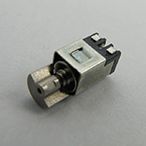
|

|
|---|---|
SMD Reflow Vibe Motor |
Spring Contact Vibe Motor |
SUMMARY OF ATTRIBUTES OF SPRING CONTACT VIBRATION MOTORS
- Lower Cost: Approx. 10% lower in cost than SMD reflow vibration motors.
- Efficient Product Assembly: Spring contacts of motor mate with corresponding contacts on the PCB. Motor is press fit into recessed pocket in shell of product housing either manually or by robotics.

|

|
|---|
- Available in higher G force ratings than SMD relow motors
- Efficient Vibration Energy Transfer: motor can be mounted in the shell of the products housing where it can efficiently transmit energy to the user with minimal dampening.
- Increased Product Reliability: Vibration has been known to contribute to product failures. Minimizing the amount of energy transfered to the PCB by not mounting the motor on the PCB is helpful in this regard.
- Superior Field Serviceability: In applications where the motor is subjected to extreme duty cycles that exceed the motors rated life, premature motor failure may occur. Replacing this type of vibrator motor, even in the field, is fast and efficient as no soldering in required to remove and replace it.
The spring contacts of these motors are not designed to be soldered to. A downward force must be applied to the top of the motors body to compress the spring contacts directly against the corresponding PCB contact pads. It is recommended that the PCB contact pads be gold plated to deter oxidation and improve reliability. Some recommended motor mounting options include, fabricating a silicone rubber pad with a cut out for the motor which will properly locate the motor directly above the PCB pads. Recesses are designed under this pad to accommodate the profiles of all the other parts that lie beneath it. When the product housing is closed, it will exert a downward pressure on the vibrator motor ensuring properly spring compression and electrical contact. Alternately, a pocket may be created in the plastic cover (shell) of the products housing to hold the motor. The motor is mounted in a silicone rubber boot that helps retain the motor in the pocket and helps dampen high frequency harmonics. When the cover is closed, the spring contacts mate with corresponding pads on the PCB.